Everything Else
Miscellanea
Marseille
Since October 2025, I’ve been working in Pierre Ronceray’s group. My main activity is understanding information-theoretic limits of inference based on realistic trajectories, which are sparse and noisy. In particular, I would like to quantify the optimal performance of any algorithm, which in turn will offer useful benchmarks to test against the best existing approaches, such as Pierre’s own SFI.
We are lucky enough to be based at Campus Luminy, just a 20-minute hike from some of the most unbelievable views in the South of France. This photo is from a casual lunch with the group on a random workday, taken by Stefano.

(Post)Modern Thermodynamics
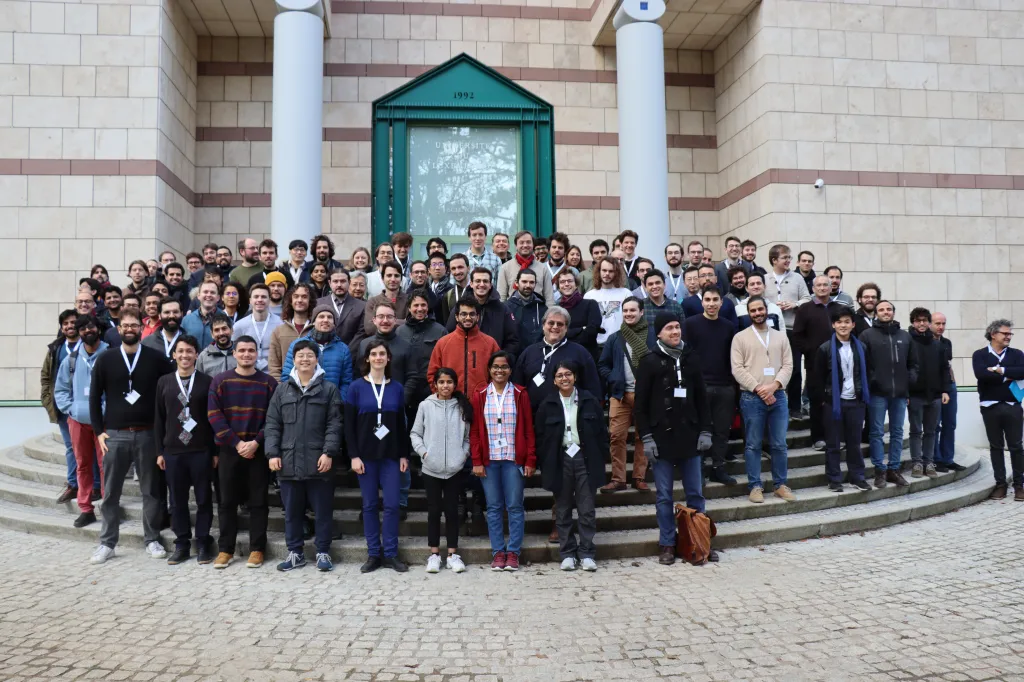
In December 2022, we organized a school and workshop that gathered 130 participants in Luxembourg. The website can still be viewed here.
The school consisted of 10 courses lectured by different experts on the basics and recent unfoldings of nonequilibrium thermodynamics. We prepared lecture notes (published in SciPost Physics Lecture Notes) that form a great resource for students and researchers interested in the field.
Kullback-Leibler estimation
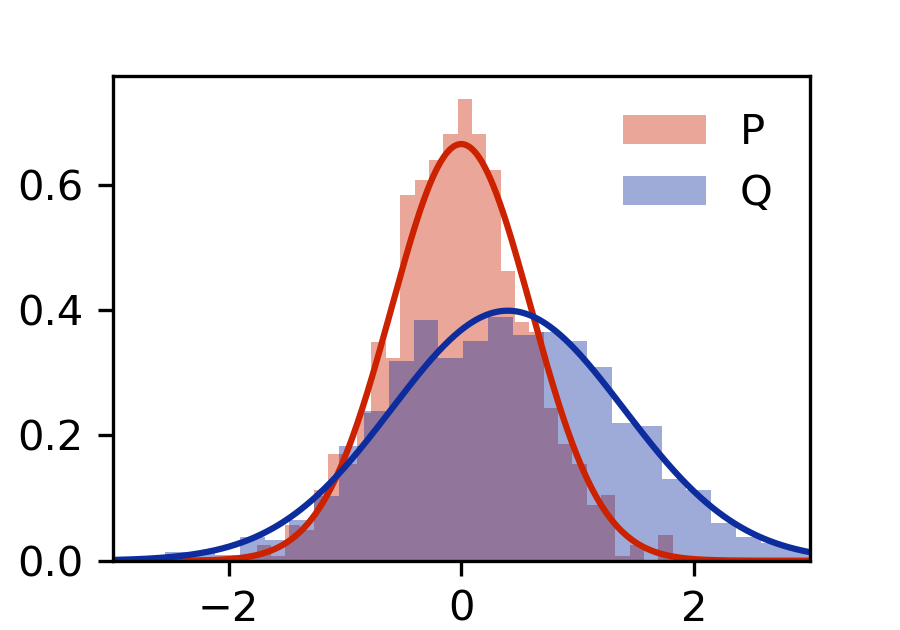
At the core of information theory, time series analysis, and even thermodynamics, is the Kullback-Leibler divergence . It measures how distinct two distributions are through their relative entropy and is used to calculate entropy production.
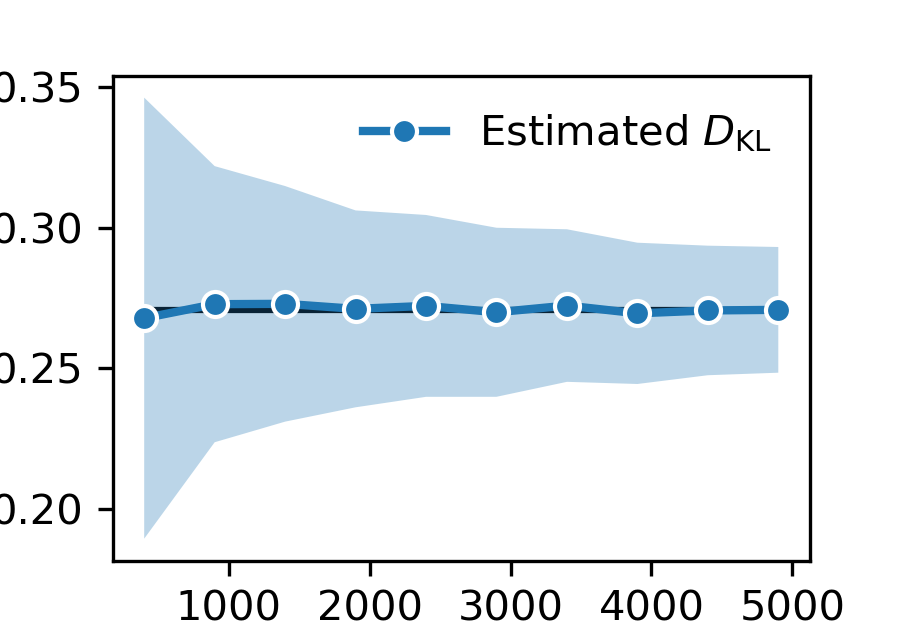
Although important, it can be tricky to empirically compute divergences from finite data, especially for continuous random variables. The most natural approach would be calculating histograms for and and directly evaluate the formula, maybe with some Kernel density estimation on top. This approach usually yield biased convergence, which can defeat the purpose: if you are looking for a lower bound, a convergence that is biased from above is a serious problem.
For continuous random-variables (with decently overlapping support), I wrote an out-of-the-box code that computes Kullback-Leibler divergences based on Fernando Pérez-Cruz’s paper “Kullback-Leibler Divergence Estimation of Continuous Distributions” (DOI:10.1109/ISIT.2008.4595271).
Other Interests
I am a fan of initiatives like arXiv, Linux, SciPost, and Lichess.
I also like the Oxford comma. LLMs made me stop using em dashes.
About this site: All content by me, all code by vibe.